
Divine Mercy Sunday
On the Sunday after Easter, the Church celebrates a feast with extraordinary promises, and an invitation to trust that no sin is beyond God's reach.
The tomb is empty. The Risen Christ has appeared to his disciples. And on the eighth day of Easter, the Church celebrates Divine Mercy Sunday.
The timing is not accidental. Mercy flows from the Resurrection. The same Jesus who conquered death now offers forgiveness to anyone who will receive it. And the promises attached to this day are extraordinary, so extraordinary that if you've never paid attention to this feast, it's worth understanding what the Church is offering.
A Polish Nun and a Message
In the 1930s, a young nun in Poland began receiving visions of Jesus.
Her name was Sister Faustina Kowalska. She was uneducated, often in poor health, and assigned to the most menial tasks in her convent: cooking, gardening, answering the door. She was not the kind of person the world notices.
But Jesus noticed her. He appeared to her repeatedly, asking her to record his words and to spread a message: that his mercy is available to all, especially to sinners who feel they have wandered too far to return.
"I desire that the Feast of Mercy be a refuge and shelter for all souls, especially poor sinners," Jesus told her. "On that day, the very depths of My tender mercy are open."
He asked that this feast be celebrated on the Sunday after Easter, the day the Church already read the Gospel of Thomas, who doubted and then believed. The day Jesus appeared to his frightened disciples and said, "Peace be with you," and breathed on them, giving them the power to forgive sins (John 20:19-23).
Sister Faustina recorded everything in her diary. She died in 1938, largely unknown. But her writings survived, and in the decades that followed, devotion to Divine Mercy spread across the world.
John Paul II and the Feast
Pope John Paul II had a particular love for this devotion. As a young man in Poland, he had lived near the convent where Faustina served. He knew her story. He understood what she had been given.
On April 30, 2000, Divine Mercy Sunday, he canonized her a saint and officially established the feast for the universal Church. It was the Jubilee Year, the turn of the millennium. And the pope chose that moment to declare to the world: God's mercy is real, it is available, and there is a day set aside to receive it.
John Paul II himself died on the vigil of Divine Mercy Sunday in 2005. His funeral Mass was celebrated on the feast. Even in death, he pointed toward mercy.
The Promises
What makes this day different from any other Sunday?
Jesus made specific promises to St. Faustina about the graces available on Divine Mercy Sunday. For those who go to Confession (either before or on the day), receive Holy Communion in a state of grace, and place their trust in Jesus, he promised a complete remission of sins and punishment, a return to the state of baptismal innocence.
That's an extraordinary claim. It sounds almost too good. But this is the logic of mercy: it is not earned, only received. God does not wait for us to become worthy. He makes us worthy by his gift.
The only condition is trust. "Jesus, I trust in You," the words inscribed on the Divine Mercy image, are the key that opens the door.
The Image
The image itself came from a vision.
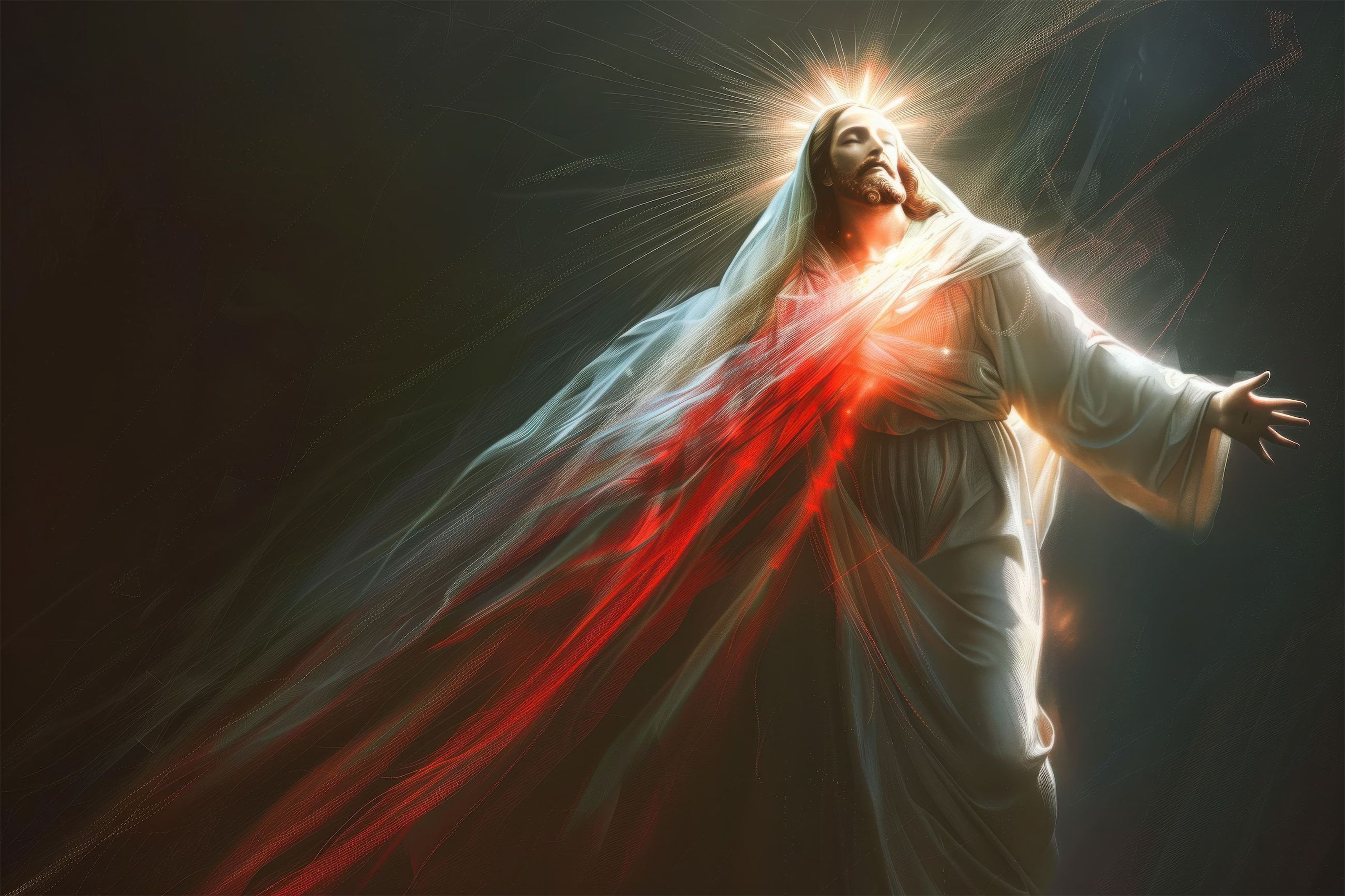
Jesus appeared to St. Faustina dressed in white, one hand raised in blessing, the other touching his breast. From his heart flowed two rays, one red, one pale. He asked her to have an image painted according to what she saw, with the words "Jesus, I trust in You" at the bottom.
He explained the rays: "The pale ray stands for the Water which makes souls righteous. The red ray stands for the Blood which is the life of souls." Blood and water, the same that flowed from his pierced side on the cross (John 19:34). The image is a window into what happened on Calvary, and what continues to flow from Christ to his Church through the sacraments.
You'll find this image in many Catholic churches. Our own parish has one in the confessional, a reminder, as you prepare to confess your sins, of the mercy waiting on the other side.
The Chaplet
Jesus also gave St. Faustina a prayer: the Chaplet of Divine Mercy.
It's prayed on ordinary rosary beads, but with different words. The heart of the prayer is this: "Eternal Father, I offer You the Body and Blood, Soul and Divinity of Your dearly beloved Son, Our Lord Jesus Christ, in atonement for our sins and those of the whole world."
And on each small bead: "For the sake of His sorrowful Passion, have mercy on us and on the whole world."
It's a prayer of offering. We don't come to God with our own merits. We come carrying Christ. We hold up his sacrifice, his Passion, his Body and Blood, and we ask the Father to look on his Son and have mercy.
Many people pray the chaplet at 3:00 PM, the hour Jesus died. It takes only about ten minutes. But those ten minutes can become an anchor for your day, a moment to remember that mercy is always being poured out.
What Do We Do With This?
Divine Mercy Sunday invites a response.
Go to Confession. If it's been a while (months, years, decades), this is the day to return. The promise of this feast is specifically for those who approach the sacrament. Don't let fear keep you away. The whole point of Divine Mercy is that God's love is greater than your sin.
Receive the Eucharist. Come to Mass in a state of grace and receive the Body and Blood of Christ. Let him enter you. Let his mercy do its work.
Pray the Chaplet. If you've never learned it, this week is a good time to start. The words are simple. The prayer is powerful.
Trust. That's the hardest part, sometimes. Not trusting that God can forgive. Most of us believe that in the abstract. But trusting that he will forgive you, specifically, for that thing you've been carrying.
Jesus, I trust in You. Say it. Mean it. See what happens.
Mercy as a Way of Life
Divine Mercy Sunday is a feast, but mercy is not confined to one day.
St. Faustina wrote in her diary: "Help me, O Lord, that my eyes may be merciful... that my ears may be merciful... that my tongue may be merciful... that my hands may be merciful... that my feet may be merciful... that my heart may be merciful."
To receive mercy is to be sent out to offer it. The measure we give is the measure we get. If we want to live in the stream of God's forgiveness, we have to let it flow through us to others.
That's harder than praying a chaplet. Forgiving the person who hurt you. Showing patience with the one who exhausts you. Extending compassion to someone who doesn't seem to deserve it.
But that's the call. Mercy received becomes mercy given.
An Open Door
No matter what you've done. No matter how long it's been. No matter how far you feel from God.
His mercy is waiting. The door is open. The rays are still flowing from his heart.
All he asks is that you come.