
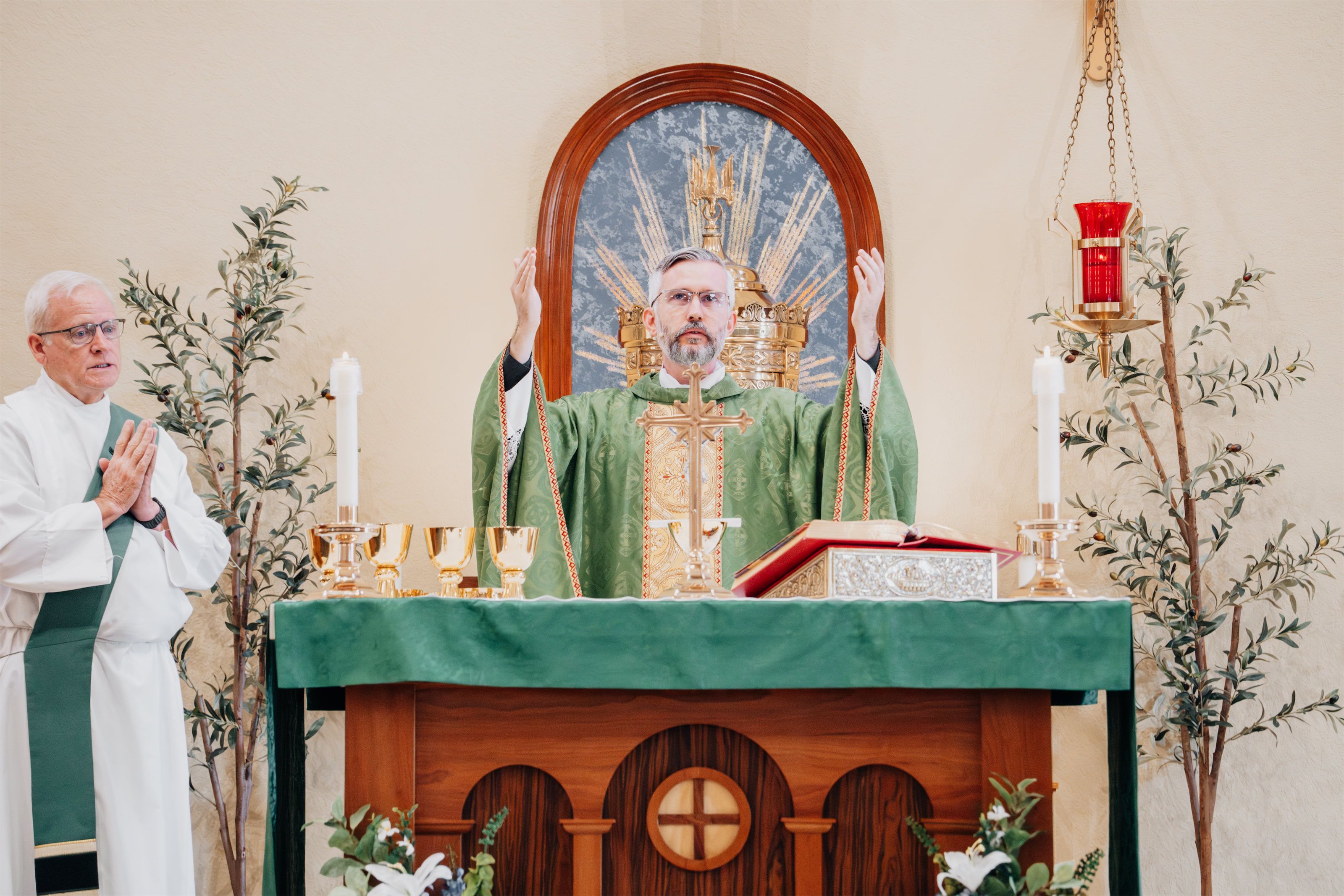
The Liturgy of the Eucharist
Bread and wine are brought to the altar. The priest speaks the words of Christ. And what was ordinary becomes holy. This is the heart of the Mass.
The Liturgy of the Word has ended. We have heard God speak through the Scriptures. We have professed our faith. We have lifted our prayers.
Now we move to the second great table.
The Liturgy of the Eucharist is not a second act or a separate event. It flows from everything that came before. The Word we heard will now become flesh on the altar. The story of salvation we listened to will become present, not as memory, but as reality.
This is the source and summit of the Christian life. Everything leads here. Everything flows from here.
The Gifts Come Forward
It begins simply. Members of the congregation bring bread and wine to the altar.
These are ordinary things, grain and grape, the work of human hands. They represent us. Our labor. Our lives. Our joys and struggles and everything we carry into this church. When the gifts are brought forward, we are brought forward.
The priest receives them, raises them slightly, and prays: "Blessed are you, Lord God of all creation, for through your goodness we have received the bread we offer you: fruit of the earth and work of human hands, it will become for us the bread of life."
Did you catch that? It will become. The transformation is already anticipated. What is ordinary is about to become extraordinary.
Water is mixed with wine, a small gesture with deep meaning. As the priest pours, he says quietly, "By the mystery of this water and wine may we come to share in the divinity of Christ who humbled himself to share in our humanity." We are being drawn into the exchange: he becomes what we are so that we might become what he is.
The Eucharistic Prayer
Then comes the Eucharistic Prayer, the heart of the entire Mass.
The priest extends his hands. "The Lord be with you." We respond, "And with your spirit." He says, "Lift up your hearts." And we answer, "We lift them up to the Lord."
Pay attention to that phrase. It's not a metaphor. We are being asked to lift our hearts, our attention, our desire, our whole selves, toward God. What happens next requires our participation, not just our presence.
The Preface follows, a prayer of thanksgiving that varies by season and feast. It recounts some aspect of God's saving work: creation, incarnation, redemption. And it ends with us joining our voices to the angels:
Holy, Holy, Holy Lord God of hosts. Heaven and earth are full of your glory. Hosanna in the highest. Blessed is he who comes in the name of the Lord. Hosanna in the highest.
We are singing with the seraphim. Isaiah saw them in the temple, crying "Holy, holy, holy" before the throne of God (Isaiah 6:3). Now we stand where heaven and earth meet, and we join their song.
The Transformation
The priest extends his hands over the bread and wine and calls upon the Holy Spirit, the epiclesis. He asks the Spirit to sanctify these gifts, to make them holy, to transform them.
Then he takes the bread.
"On the night he was betrayed, he took bread, and giving thanks, broke it and gave it to his disciples, saying: Take this, all of you, and eat of it, for this is my Body, which will be given up for you."
He elevates the host. We look. We believe.
Then the chalice.
"Take this, all of you, and drink from it, for this is the chalice of my Blood, the Blood of the new and eternal covenant, which will be poured out for you and for many for the forgiveness of sins. Do this in memory of me."
He elevates the chalice.
What was bread is now the Body of Christ. What was wine is now his Blood. Not symbolically. Not metaphorically. Really, truly, substantially. The Church calls this transubstantiation, the substance changes while the appearances remain. It is a mystery beyond our comprehension, but not beyond our faith.
The priest announces, "The mystery of faith," and we respond with one of several acclamations: "We proclaim your death, O Lord, and profess your Resurrection until you come again."
This is what we are doing. Proclaiming. Professing. Waiting. The Mass makes present the sacrifice of Calvary, the same sacrifice, offered now on this altar, until he comes again.
The Great Amen
The Eucharistic Prayer continues with prayers for the Church, for the living and the dead, for all the saints. It gathers up the whole communion of believers across time and space.
And it ends with the doxology. The priest lifts the Body and Blood of Christ and proclaims:
"Through him, and with him, and in him, O God, almighty Father, in the unity of the Holy Spirit, all glory and honor is yours, for ever and ever."
And we sing or say: Amen.
This is the Great Amen, the most important word we speak in the entire Mass. It means "So be it" or "Yes, it is true." With that word, we assent to everything that has just happened. We make the priest's prayer our own. We affirm the sacrifice. We say yes to Christ.
It's a small word that carries everything.
The Communion Rite
Now we prepare to receive.
We pray the Lord's Prayer together, the Our Father, asking for daily bread that is more than bread. We exchange a sign of peace, recognizing that we cannot receive Christ if we are divided from one another. The priest breaks the host, the fraction, while we sing or say the Agnus Dei: "Lamb of God, you take away the sins of the world, have mercy on us."
Then comes the invitation.
The priest holds up the broken host and says, "Behold the Lamb of God, behold him who takes away the sins of the world. Blessed are those who are called to the supper of the Lamb."
These words echo John the Baptist at the Jordan: "Behold, the Lamb of God" (John 1:29). They echo the wedding feast of the Lamb in Revelation (Revelation 19:9). We are standing at the intersection of history and eternity.
We respond with the words of the centurion: "Lord, I am not worthy that you should enter under my roof, but only say the word and my soul shall be healed" (cf. Matthew 8:8).
And then we come forward.
Receiving
A word before we go forward: not everyone can receive.
Catholics who are in a state of grace, free from unconfessed mortal sin, are invited to receive Holy Communion. If you are not Catholic, or if you are Catholic but not properly disposed to receive, you are still welcome to come forward. Simply cross your arms over your chest, and the minister will offer a blessing instead.
This isn't exclusion. It's honesty about what Communion is. To receive the Eucharist is to say "Amen" to everything the Church believes and teaches. It's a sign of full communion, with Christ and with his Church. Those who are still on the journey toward that communion are welcomed, honored, and blessed. But the sacrament itself is reserved for those who are ready to receive it.
If it's been a while since your last confession, this might be the nudge you need. The sacrament of Reconciliation restores us to full communion. The priest is available. The mercy is waiting.
For those who do receive: you may receive the host on the tongue or in the hand, both are permitted. If in the hand, place one palm over the other, receive the host, step aside, and consume it immediately. The minister says, "The Body of Christ." You answer, "Amen." Yes. I believe.
If the Precious Blood is offered, the same: "The Blood of Christ." "Amen."
What is happening at this moment?
God enters your body. The same Christ who walked in Galilee, who died on Calvary, who rose from the tomb. He comes to dwell in you. You become, for that moment and beyond, a living tabernacle.
What do you do with that?
After Communion
The moments after Communion are not a time to check your phone or flip through the hymnal. They are among the most precious moments of the entire Mass.
You have just received Christ. He is within you. Talk to him. Thank him. Sit in the silence. Ask for what you need. Offer him what you have. Let the encounter linger.
The priest will offer a Prayer after Communion, asking that the sacrament bear fruit in our lives. And then the Mass will end, but what we have received does not end. We carry it with us. We are sent out as living vessels of the presence we have consumed.
The Weight of It
The Catechism calls the Eucharist "the source and summit of the Christian life" (CCC 1324). Source, everything flows from it. Summit, everything leads to it.
This is not an exaggeration. This is the Church's understanding of what happens at every Mass, in every parish, every day. The sacrifice of Christ made present. The Body and Blood given for us. Heaven opened. Eternity breaking into time.
Do we approach it that way?
If we really believed what we say we believe, that this is the Body of Christ, that God himself is present, that we are receiving the medicine of immortality, would we come late? Would we leave early? Would we receive him without a thought and walk back to our seats scrolling through our minds for what's next on the schedule?
The Liturgy of the Eucharist invites us to slow down. To pay attention. To recognize what is being offered and who is being given.
Come hungry. Come reverent. Come expecting to be changed.
This is the heart of the Mass. This is the Lord.