
Holy Week
From the palms of Sunday to the empty tomb, this is the week that holds everything. Here's what happens, and why it matters.
Holy Week is not a series of events. It's a single drama, unfolding over seven days, pulling us into the heart of our faith. Everything the Church believes and celebrates finds its source here: in Jesus' entry into Jerusalem, his last meal with his disciples, his arrest and trial, his death on the cross, his rest in the tomb, and his rising to life.
We don't just remember these things. We enter them. The liturgies of Holy Week are not reenactments for spectators. They're invitations.
Come and walk with him.
Palm Sunday: Hosanna and Crucify
Holy Week begins with a strange liturgy.
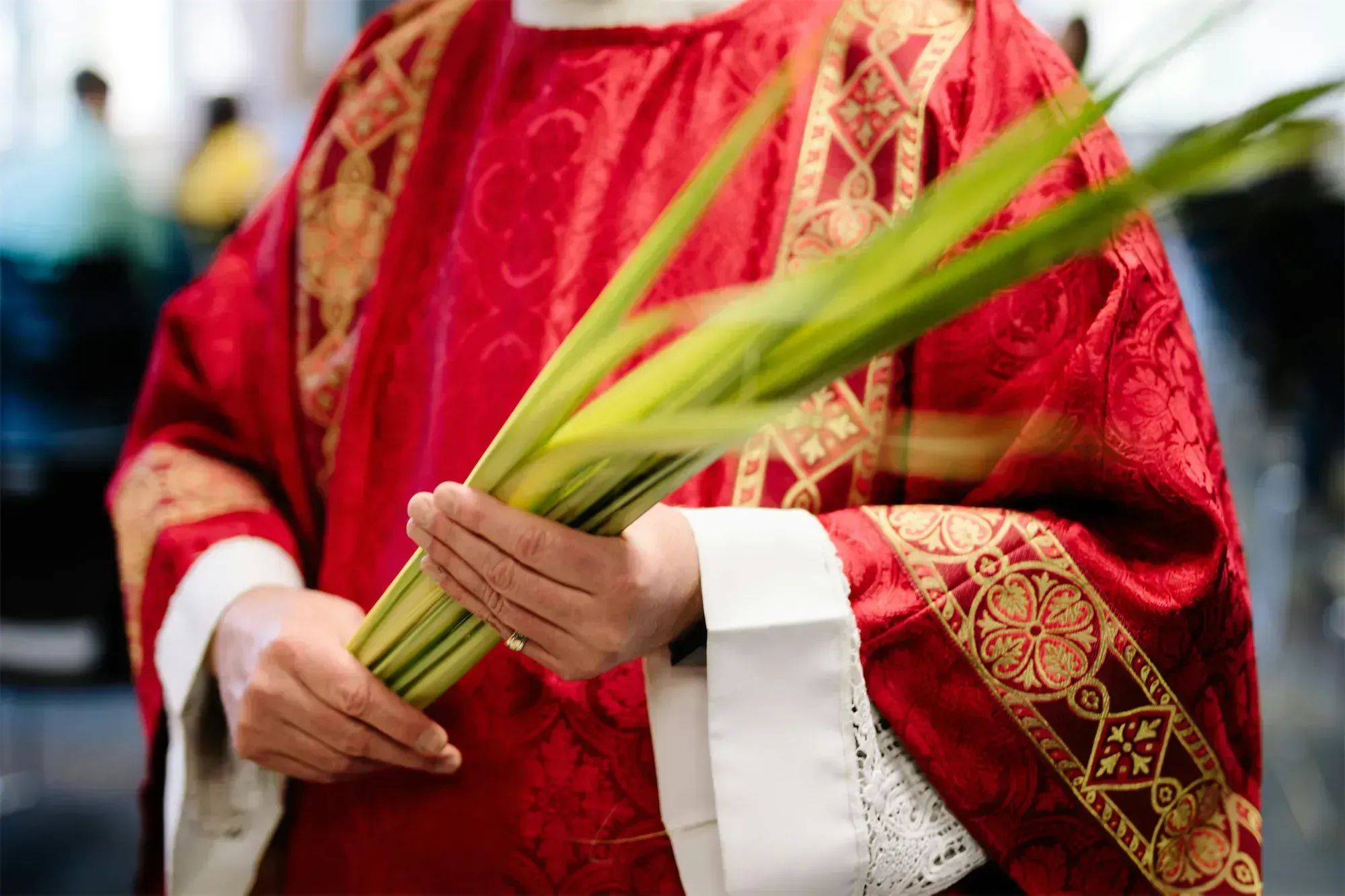
We gather outside, receive palm branches, and process into the church singing hymns of praise. "Hosanna to the Son of David! Blessed is he who comes in the name of the Lord!" (Matthew 21:9). It's triumphant. The palms recall the crowds who welcomed Jesus into Jerusalem, spreading branches and cloaks in his path.
And then, within the same Mass, we read the Passion.
The Gospel account of Jesus' arrest, trial, and crucifixion is proclaimed in full, often with the congregation taking the part of the crowd. The same voices that sang "Hosanna" now cry "Crucify him."
Have you ever noticed how easily the mood shifts? How quickly the crowd turns? It's uncomfortable to stand there and say those words. And maybe that's the point. The distance between adoration and betrayal is shorter than we'd like to admit.
We are not just observers of this story. We are somewhere in it. The question Palm Sunday raises is: where?
The Sacred Triduum
The final three days of Holy Week (Holy Thursday, Good Friday, and Holy Saturday) form what the Church calls the Sacred Triduum. The word means "three days," but it's really one continuous liturgy stretched across three evenings.
It begins on Holy Thursday night and doesn't conclude until the Easter Vigil. The tabernacle is emptied. The altar is stripped bare. The church falls silent. We enter a kind of suspended time, walking with Jesus through his suffering, death, and burial, waiting for the Resurrection.
If you've never attended the Triduum, this is the year to begin. Clear the calendar. Rearrange what needs rearranging. These are the holiest hours of the Christian year.
Holy Thursday: The Night He Was Handed Over
On Thursday evening, we remember the Last Supper.
St. Paul gives us the earliest account: "The Lord Jesus, on the night he was handed over, took bread, and after he had given thanks, broke it and said, 'This is my body that is for you. Do this in remembrance of me'" (1 Corinthians 11:23-24). At this meal, Jesus institutes the Eucharist, the gift he will leave us. He also washes the feet of his disciples, commanding them, and us, to do the same for one another (John 13:1-17).
Think about what he's doing. He knows Judas will betray him. He knows Peter will deny him. He knows they will all scatter. And still he kneels before them with a towel and a basin. Still he gives them his Body and Blood.
What kind of love is this?
The Mass of the Lord's Supper includes the washing of feet, a visible sign of the service we're called to. The Gloria is sung for the first time since Lent began, and the bells ring, then fall silent. They will not ring again until the Easter Vigil.
After Communion, the Blessed Sacrament is carried in procession to an altar of repose, often in a side chapel. The main altar is stripped bare. The holy water fonts are emptied. The church becomes a place of watching.
Jesus asked his disciples in Gethsemane, "Could you not watch one hour with me?" (Matthew 26:40). They couldn't. They fell asleep while he sweat blood.
On Holy Thursday night, parishes often keep the church open for adoration. We're given another chance. Could we stay awake with him? Even for an hour?
Good Friday: The Cross
Good Friday is the starkest day of the liturgical year.
There is no Mass. The Church does not celebrate the Eucharist on the day Christ died. The one sacrifice is enough. Instead, we gather in the afternoon for the Liturgy of the Lord's Passion.
The Passion according to John is proclaimed. We hear of his arrest, his trial before Pilate, his scourging and crowning with thorns. We hear him say to his mother, "Woman, behold your son," and to the beloved disciple, "Behold your mother" (John 19:26-27). We hear his final words: "It is finished" (John 19:30).
What do we do with this?
There's no way to make the crucifixion comfortable. A man is tortured to death. He hangs there for hours. His mother watches. And we believe this is the hinge of history: everything turns on this wood, this body, this blood.
Then comes the Veneration of the Cross. A crucifix is unveiled and presented to the congregation. One by one, we approach. We kneel. We kiss the wood, or touch it, or simply bow. We reverence the instrument of our salvation.
Why do we call this day "good"?
Not because suffering is good. Not because death is good. But because what he accomplished on this cross is good: good for us, for the world, for all of history. He took the worst we could do and turned it into the means of our rescue.
The altar remains bare. The tabernacle is empty. We leave in silence, carrying the weight of what we've witnessed. There's nothing to say. Not yet.
Holy Saturday: The Waiting
Holy Saturday is the forgotten day, and perhaps it should be.
Nothing happens liturgically during the daylight hours. The Church waits. Jesus lies in the tomb. The disciples are scattered and grieving. Creation holds its breath.
Do you know this feeling? The day after something terrible, when you're not sure what comes next? When the loss is still fresh and the future is blank?
This is where the disciples lived on that first Holy Saturday. Their teacher was dead. Their hopes were buried with him. They didn't know the story would continue. They only knew it had stopped.
The ancient tradition speaks of Christ's "descent to the dead", his journey to the realm of those who died before him, to proclaim liberation to the righteous who had been waiting since the beginning of the world. We profess this in the Creed: "He descended into hell." Not the hell of the damned, but Sheol, the place of the dead, the silence where all souls waited for redemption.
Even there, he goes. Even into death, he carries the light.
On Holy Saturday, the church is bare. The tabernacle stands open and empty. There is no Eucharist to receive, no bells to ring, no alleluia to sing. We sit in the silence with those first disciples, not yet knowing what the morning will bring.
And we wait.
The Easter Vigil: Light in the Darkness
After nightfall on Holy Saturday, the Church gathers for the mother of all vigils.
It begins in darkness. Total darkness. The kind of darkness that makes you aware of your own breathing.
Then a fire is kindled outside the church. From it, the Paschal candle is lit, a great pillar of wax representing Christ, the Light of the World. The deacon or priest carries it into the darkened church, singing three times: Lumen Christi, the Light of Christ.
And one by one, candle by candle, the light spreads. Faces emerge from the darkness. The church fills with flickering flames, each one lit from the single source.
What must it have been like for those early Christians, gathering in the dark, waiting for the light? What is it like for us, who live in a world that rarely goes fully dark, to stand in a church with no electric lights and watch the fire spread?
Then comes the Exsultet, the great Easter proclamation. The deacon sings: "Rejoice, heavenly powers! Sing, choirs of angels! Exult, all creation around God's throne! Jesus Christ, our King, is risen!"
The Liturgy of the Word unfolds with reading after reading, up to nine of them, tracing salvation history from creation through the Exodus to the prophets. We hear the story of the world God made, the people he called, the promises he kept. We remember how long humanity waited for this night.
Then the water is blessed. Catechumens who have been preparing, sometimes for years, are baptized, confirmed, and receive the Eucharist for the first time. They rise from the water. They are clothed in white. They have passed through death into life.
The Gloria returns. The bells ring out, the same bells that fell silent on Holy Thursday. The Alleluia, buried since before Lent, is sung again.
And the Eucharist is celebrated for the first time since the Lord's Supper.
This is the night. This is when everything turns. If you attend only one liturgy this year beyond Sunday Mass, let it be this one.
Easter Sunday: He Is Risen
Easter Sunday morning continues what the Vigil began.
The church is filled with light, flowers, music, joy. The readings proclaim the empty tomb: "He is not here; he has risen" (Luke 24:6). The stone is rolled away. The grave clothes are folded. He is not there because he is alive.
What do you do with news like that?
The women who went to the tomb that morning didn't know what to think. Neither did Peter or John when they ran to see for themselves. The Resurrection was not something they expected. It was something that happened to them, something that rearranged everything they thought they knew about death and life and God.
It still does.
Easter is not just a day. It's a season, fifty days stretching to Pentecost. The Church doesn't rush past the Resurrection. She dwells in it. She lets the reality sink in slowly, the way the disciples came to understand only gradually that their teacher was alive.
Christ is risen. Death has been defeated. The story did not end at the tomb.
An Invitation
If you've never walked through Holy Week fully, attending Palm Sunday, Holy Thursday, Good Friday, and the Easter Vigil, consider this your invitation.
It's a commitment. The Triduum services are long. They ask something of you. But there is nothing else like them in the Church's year.
To enter Holy Week is to enter the story of your salvation. Not as a spectator, but as a participant. To kneel at the cross and wonder what kind of love would do this. To sit in the silence of Saturday and feel the weight of the waiting. To watch the light spread through the darkness and know that it has come for you.
Come and walk with him. From the palms to the cross to the empty tomb.
This is the week that holds everything.