
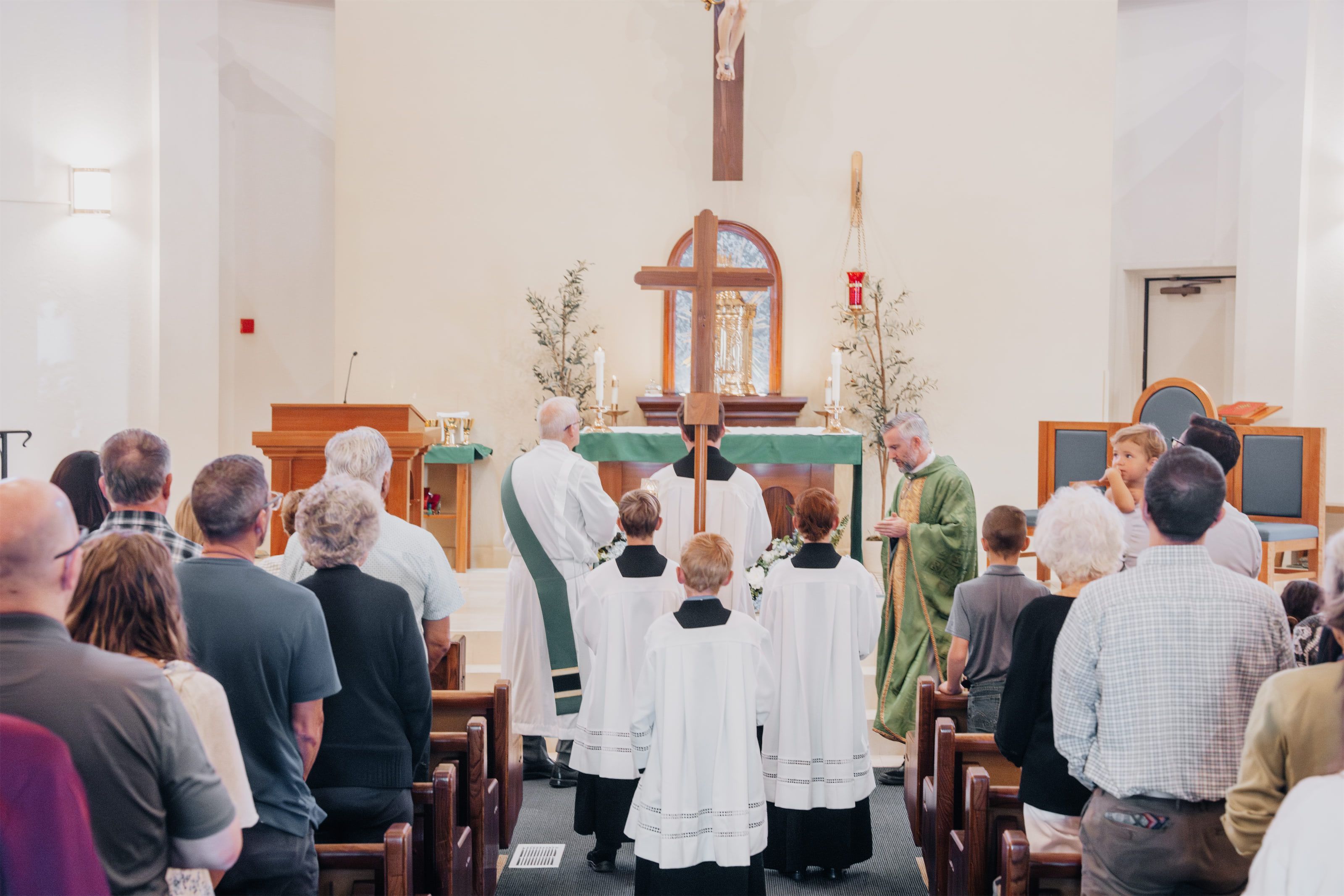
Altar Servers
They carry the cross, ring the bells, and stand closer to the altar than almost anyone else in the parish. For many young people, this is where the liturgy becomes part of them.
Watch an altar server during Mass. They're often young, fourth grade, maybe fifth. They process in carrying the cross or the candles. They stand near the altar, move when the rubrics require, kneel at the consecration. They ring the bells.
To some, it might look like a set of tasks a child can be trained to do. And in one sense, it is. But something deeper is happening.
These young people are learning the Mass from the inside. Not by reading about liturgy in a book, but by moving through it. By standing close enough to see the priest's hands over the bread and wine. By hearing the Eucharistic Prayer not from the pew but from the sanctuary. By ringing the bells at the moment Christ becomes present on the altar.
The liturgy shapes them from the inside out.
What Servers Do
The tasks of an altar server are simple, but each one carries weight.
They carry the processional cross and candles, leading the assembly into worship. The cross goes first, always. It's a reminder that everything in the liturgy follows from the Cross.
They hold the Roman Missal for the priest during the prayers, freeing his hands for the gestures of blessing and supplication.
They assist with the preparation of the gifts, presenting the bread, wine, and water, pouring water over the priest's hands as he prays, "Wash me, O Lord, from my iniquity."
On certain occasions, they carry the thurible and manage the incense, adding that ancient sign of prayer rising to heaven.
And at the consecration, they ring the bells, a sharp, clear sound that cuts through everything and says: pay attention. This is the moment. He is here.
None of this is complicated. All of it is formative.
Learning Reverence
You can tell children that the Eucharist is sacred. But when they stand at the altar, when they kneel on the hard floor during the Eucharistic Prayer, when they handle the cruets and see the priest's reverence up close, they begin to know it in a different way.
Altar serving teaches reverence by doing. It teaches responsibility: show up on time, vest properly, know your role. It teaches humility: you are there to serve, not to be seen.
These are virtues that shape a life. And they're learned not in a classroom but in the sanctuary, week after week, through the rhythm of the liturgy.
A Seedbed for Vocations
The Church has long recognized that altar serving can plant seeds of vocation. Many priests, when asked where their calling began, point to their years serving at the altar.
This makes sense. If you want to know whether you're called to something, get close to it. Altar servers are as close to the priesthood as a young person can get without being ordained. They see what the priest does. They assist in the sacred action. And for some, a quiet question begins to form: Could this be for me?
Not every server will become a priest or religious. But every server is being formed, learning what it means to serve the Lord and his Church.
Who Can Serve?
At St. John the Evangelist, altar servers are typically young people who have received First Holy Communion, usually fourth grade and up. Many come from St. John the Evangelist Catholic Academy, though the ministry is open to all young parishioners. Training is provided. No prior experience is required, just a willingness to learn and a desire to serve.
Adults can serve as well, especially when needed. But there's something fitting about young people in this role. The Church has always made room for children in her worship. Jesus himself said, "Let the children come to me." At the altar, they do.
An Invitation
If your child has received First Communion and shows interest in serving, encourage them. This ministry is a gift, not just to the parish, but to the young person who takes it on.
And if you're a parent watching your child serve for the first time, pay attention. Watch them carry the cross. Watch them kneel at the consecration. Something is being formed in them that will last.
We speak of our parish as a "School of Prayer." The sanctuary is where that school meets. And those who serve there, young as they are, are learning more than they know.